
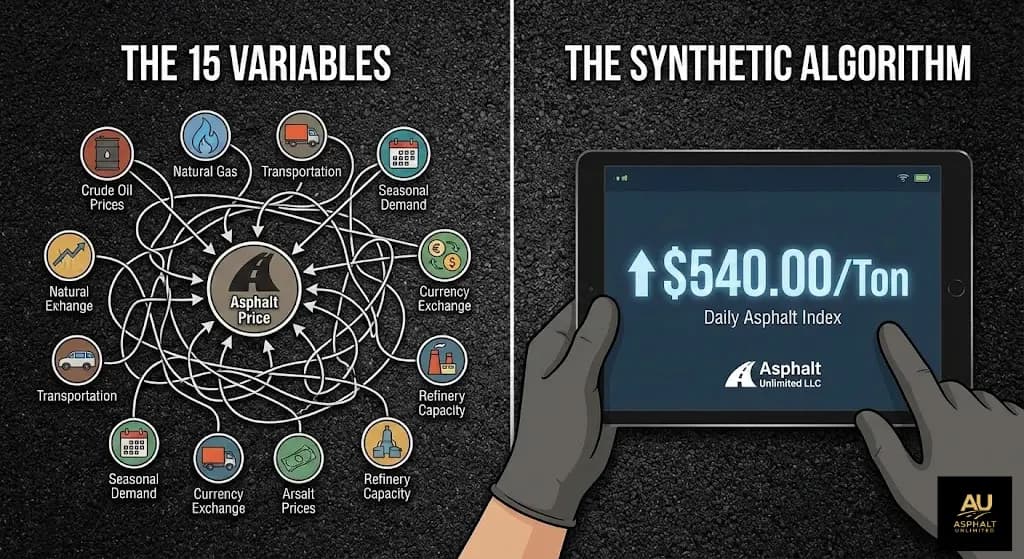
If you've been in the asphalt business for any length of time, you know that pricing can feel like a moving target. One month you're getting quotes at one price, the next month those same suppliers are coming in significantly higher or lower. It's frustrating, unpredictable, and it makes bidding projects feel more like gambling than business planning.
At Asphalt Unlimited LLC, we often tell people that approximately 15 variables go into asphalt pricing. The response is usually the same: a mixture of surprise and concern. Fifteen variables? How is anyone supposed to keep track of all that?
The good news is you don't have to. But understanding what these variables are and how they interact can help you make better decisions for your business.
The 15 Variables Explained
Let's break down the factors that influence what you pay for liquid asphalt:
Energy and Crude Markets (The Big Movers)
1. Crude Oil Prices: The foundation of everything. Asphalt is literally the bottom of the barrel in crude oil refining, so when crude moves, asphalt follows.
2. Natural Gas Prices: Refineries burn massive amounts of natural gas to process crude oil. Higher gas prices mean higher refining costs.
3. Heating Oil and Diesel Prices: These products compete with asphalt in the refining process. When heating oil demand spikes in winter, refineries shift production away from asphalt.
4. Gasoline Prices: Summer driving season affects more than just your fuel costs. When gasoline is in high demand, refineries prioritize it over asphalt production.
5. Propane and Light End Values: These lighter petroleum products affect the overall economics of refinery operations.
Supply Chain and Logistics
6. Transportation and Freight Costs: The distance from refinery to your location matters. Fuel costs, driver availability, and shipping logistics all factor in.
7. Regional Supply and Demand: Local market conditions can create significant price variations. An area with multiple refineries will have different pricing than a region dependent on rail shipments.
8. Refinery Capacity Utilization: When refineries run at full capacity, supply is abundant. When they cut production or go offline for maintenance, prices can spike.
9. Inventory Levels: Both supplier and industry-wide inventory levels affect pricing. Low inventories mean less flexibility and higher prices.
10. Seasonal Demand Patterns: Construction season drives demand. Everyone wants asphalt in the spring and summer, which affects both availability and pricing.
Financial and Economic Factors
11. Currency Exchange Rates: For imported crude or asphalt, exchange rates matter. A weak dollar means higher costs for imported materials.
12. Interest Rates: The cost of financing inventory affects supplier pricing. When interest rates rise, carrying costs increase.
13. Credit Risk and Payment Terms: Your payment history and terms affect your pricing. Suppliers price in their risk and financing costs.
14. Futures Market Conditions: Forward pricing curves in energy markets signal where costs are heading, affecting supplier willingness to commit to fixed prices.
Product Specifications
15. Quality and Grade Requirements: Different asphalt grades (PG 64-22, PG 76-22, polymer modified, etc.) have different costs. Specialty products command premium prices.
The Overwhelming Reality
Looking at this list, you might be thinking: "There's no way I can track all of this." You're absolutely right. Even if you had the time and expertise to monitor crude oil markets, natural gas prices, refinery capacity reports, freight indices, and currency markets, by the time you processed all that information, the market would have already moved.
This is exactly the problem we set out to solve when we developed The Synthetic algorithm. We realized that contractors and asphalt plant owners shouldn't have to become energy market analysts just to run their businesses effectively.
How The Synthetic Simplifies Everything
Over the years, we studied these 15 variables and their relationships to actual asphalt pricing. We analyzed 17 years of market data, ran countless correlations, and developed a mathematical model that captures how these variables interact and influence asphalt costs.
The result is The Synthetic, an algorithm that automatically tracks the relevant energy markets, applies the appropriate weightings, accounts for regional and seasonal factors, and produces a single, actionable number: what asphalt should cost.
When we backtested this algorithm against 17 years of published Coker Values (the industry standard for alternative asphalt pricing), we achieved a Pearson correlation of 0.98324. That's as close to perfect correlation as you can get in financial markets.
What This Means for Your Business
Instead of trying to be an expert in energy markets, refining economics, and financial analysis, you can focus on what you do best: running your asphalt business. Here's how understanding these variables (without tracking them yourself) helps:
Informed Decision Making: When your supplier tells you prices are going up, you'll understand the legitimate market forces behind it rather than wondering if you're being taken advantage of.
Better Timing: You'll know when to fill your tanks and when to wait, based on real market intelligence rather than gut feeling.
Smarter Bidding: For multi-year projects, you can estimate future costs with confidence instead of pulling numbers out of thin air or padding your bids so much that you lose on price.
Risk Management: Understanding price volatility helps you decide when Price Protection makes sense and when you can safely work without it.
The Advantage of Market Intelligence
Some of your competitors are still guessing. They look at last month's invoice, add a percentage, and hope for the best. Others build in huge safety margins that make them uncompetitive. A few try to track crude oil prices on their phones and think that tells the whole story.
But the contractors and plant owners who work with real market intelligence, who understand that 15 variables are at play even if they don't track each one individually, are making better decisions. They're winning more bids at healthy margins. They're managing their inventory more effectively. They're sleeping better at night because they're not guessing about their largest material cost.
You Don't Need to Track Everything
The beauty of modern market analysis is that you don't have to do it yourself. Just like you don't need to understand the engineering behind your paving equipment to operate it effectively, you don't need to track 15 market variables to benefit from the intelligence they provide.
What you do need is access to that intelligence in a format you can actually use. That's why we created the Daily Asphalt Index and The Asphalt App. Every morning, these tools process overnight energy market closings, run them through The Synthetic algorithm, and deliver updated pricing expectations for your region and timeframe.
It's all 15 variables, distilled into one number you can actually use.
The Bottom Line
Asphalt pricing is complex. Fifteen different variables pull it in different directions every single day. Trying to track and understand all of them yourself isn't realistic or necessary.
What is necessary is recognizing that these forces exist, that they're measurable, and that market intelligence can give you a significant competitive advantage. The question isn't whether you should understand asphalt pricing better. The question is whether you're going to leverage the tools that make that understanding practical and actionable.
At Asphalt Unlimited LLC, we've spent decades mastering these 15 variables so you don't have to. We comprehend those variables so you don't have to.